


With increasing regulatory scrutiny under the Regulatory Reform (Fire Safety) Order 2005, Fire Safety Act 2021, and Fire Safety (England) Regulations 2022, Responsible Person(s) (RP) and property stakeholders face greater expectations to properly assess, manage and document fire risk.
In this blog we’ll be highlighting some expectations and duties of the Responsible Person, and what good fire safety management looks like. For an in-depth exploration on the topic, including what to consider depending on the property size and its usage, refer to our webinar under the same name: Fire Risk Management: what every Responsible Person needs to know.
Who is the Responsible Person?
The Responsible Person (RP) is someone with a degree of control over the premises. In a property management setting, this can be multiple persons or entities. It could be the landlord, for example, or property owner, managing agent, an employer, or even a tenant within the building.
The Expectations on Responsible Person(s)
Legal framework (correct at time of publishing)
|
Regulatory Reform (Fire Safety) Order 2005 (FSO) |
Duty placed upon the ‘Responsible Person’ to carry out, and record, a suitable fire risk assessment (FRA) and to implement appropriate fire safety measures. |
|
Fire Safety Act 2021 |
Amends the FSO to clarify that it applies to the structure, external walls (including balconies, doors and windows) and flat entrance doors in multi-occupied residential buildings with two or more sets of domestic premises. |
|
Fire Safety (England) Regulations 2022 |
Introduced new mandatory requirements, based on building height, with particular focus on provision of information to residents, fire door inspections, and 18m+ buildings. |
|
Future Legislation |
The Fire Safety (Residential Evacuation Plans) (England) Regulations 2025 Introduced in April 2026.
Further legislation relating to fire risks inside dwellings are being considered. |
Approved guidance
Typically when a legislation is introduced, the legislation itself will set general objectives, meanwhile the guidance, issued under Article 50 of The Regulatory Reform (Fire Safety) Order 2005, provides more detail on how duty holders can comply to legislation.
Though the guidance is not legally binding, enforcing authorities and courts may refer to it when assessing whether legal duties have been met.
How broad is the scope of responsibility?
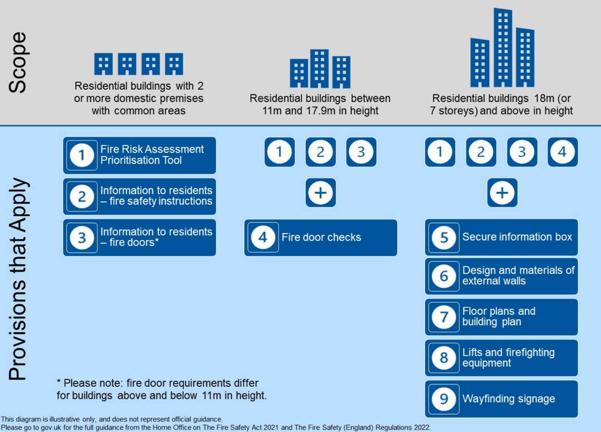
While the below was released alongside official guidance, and is for illustrative purposes only, it demonstrates the expectations on RPs and provisions that apply depending on the scope of property.
The RP’s duties: Fire Risk Assessments
As depicted in the previous diagram, a Fire Risk Assessment (FRA) should form the foundation of fire risk management policies in any building that falls within scope of the legislation.
When completing an FRA, it must be ‘Suitable and Sufficient’, meaning it should not be considered a tick box or generic exercise.
The FRA must identify significant risks, provide proportionate recommendations tailored to the specific building and occupancy profile, and it must record full and correct building information and include commentary on existing good practices.
The FRA and Fire Risk Assessor
As part of the FRA’s completion, and to ensure its suitability, the Responsible Person remains legally responsible for appointing a competent Fire Risk Assessor.
To do this, they should look for qualifications and experience of similar premises, and Third party accreditation via recognised bodies such as BAFE, Institution of Fire Engineers (IFE), Institute of Fire Safety Managers (IFSM).
The FRA and Fire door inspections
Fire door inspections are not only key to good fire risk management overall, but important to the FRA. The extent of reviews can vary as follows:
Routine Checks
• As described in the FSER and Article 50 guidance
• These are basic checks to confirm the function of the assembly, self-closers, gaps, condition of smoke seals and intumescent strips, and other factors such as missing screws/ironmongery or damage to the doors
• The frequency of checks can depend on the building and risk level
• They must be carried out by a competent individual who understands what the check entails, and signs to watch for.
Specialist Surveys
• More intrusive, e.g removing architraves, checking behind ironmongery etc.
• Benchmarking against certified standard, products specifications and the standard of installation
• Carried out by specialists
• May be used to inform the Fire Risk Assessment to help determine the suitability of the door set, particularly during an intrusive assessment.
The RP’s duties: management arrangements
Once information has been gathered for the FRA, the responsibility doesn’t end there. RPs must oversee fire safety management arrangements properly, which means:
• A clear policy
• Providing suitable training to those with fire safety duties
• Sharing of information
• Action/Task Management and record keeping
• Input into wider building management arrangements, e.g. Safety Cases and The Golden Thread under The Building Safety Act 2022.
The RP’s duties: key takeaways
• The onus is on the Responsible Person(s) to manage fire risk
• Fire Risk Assessments must be ‘suitable and sufficient’ and completed by competent persons
• The approach to fire risk management should be proportionate to the level of risk
• The suitability of fire doors is a matter for the fire risk assessment
• Measures should be properly recorded, tracked and reviewed.
Want to know more?
Whether you need guidance on risk management and property, or wish to discuss your insurance requirements, our specialists are here to help. Visit the respective pages below for more information.
Webinar: ‘Fire Risk Management: what every Responsible Person needs to know’
Further reading: The importance of fire door and health and safety inspections